


Some companies lose freight business because their rates weren’t competitive.
Most lose freight business because the invoicing didn’t add up.
It rarely starts with a dramatic incident.
It starts with a quiet email:
“We’re reconciling Q2 freight — can you explain the 11% accessorial increase year-over-year?”
The operational team scrambles. Analysts dig through carrier PDFs. Someone spots a reclassification pattern. Someone else notices a fuel-index shift that didn’t match the negotiation. The explanations take days — not because the provider is incompetent, but because there is no mechanism to validate billing at scale.
If a logistics management partner can’t answer these questions instantly and confidently — they lose authority.
And once authority erodes, renewal conversations turn into price-pressure conversations.
The problem isn’t effort or intent — it’s bandwidth.
Modern freight billing moves faster than humans can validate.
That is the existential risk.
The freight-management model was built on expertise and relationships. But expertise cannot manually evaluate 10,000 invoices a month — and relationships don’t fix mathematics. The industry already understands that freight execution scaled through TMS and optimization engines.
Now it’s accepting a harder truth:
Freight auditing did not scale.

The more successful the provider, the bigger the client, the more fragmented the carrier mix — the less realistic manual validation becomes. And in a financial relationship, nothing erodes authority faster than telling a CFO, “We’re looking into it.”
That is why AI Agents don’t signal automation for efficiency — they signal credibility preservation.
The Problem: Manual Freight Audits Don’t Scale With Modern Billing Complexity
Logistics management firms — including advanced 3PLs and 4PLs — sit in a unique position:
You don’t generate invoices, but clients expect you to verify every line item anyway.
Carrier billing has become a moving target:
- weekly fuel index adjustments
- regional accessorial policies
- density-class recalculations
- dimensional logic on parcel
- cubic-minimum triggers
- minimum-charge enforcement
And every carrier applies these rules differently.
For 4PLs managing layered networks across regions, modes, and execution partners, this variability compounds quickly.
Most freight-management teams still perform bill validation like this:
- download the weekly invoice batch
- compare two numbers
- move on to execution priorities
That process is built for 50 invoices a week — not 5,000.
The Shift: AI-Driven Freight Bill Auditing
The role of an AI Audit Agent isn’t to replace your operations or your carrier expertise.
Its role is to perform the computational verification humans were never meant to do manually.
The Agent:
- ingests every invoice automatically
- extracts granular line-item pricing
- validates every charge against contracted terms
- checks rules dynamically as they evolve
- flags only anomalies for human review
- learns carrier patterns over time
Humans still make judgment calls.
AI just ensures nothing gets buried in the volume.
How an AI-Powered Freight Bill Audit Actually Works
Traditional freight audits rely on sampling, spreadsheets, and human memory. That approach breaks the moment invoice volume, carrier mix, or accessorial complexity increases.
An AI-powered freight bill audit replaces manual review with a systematic validation loop that runs continuously, before invoices are approved for payment.
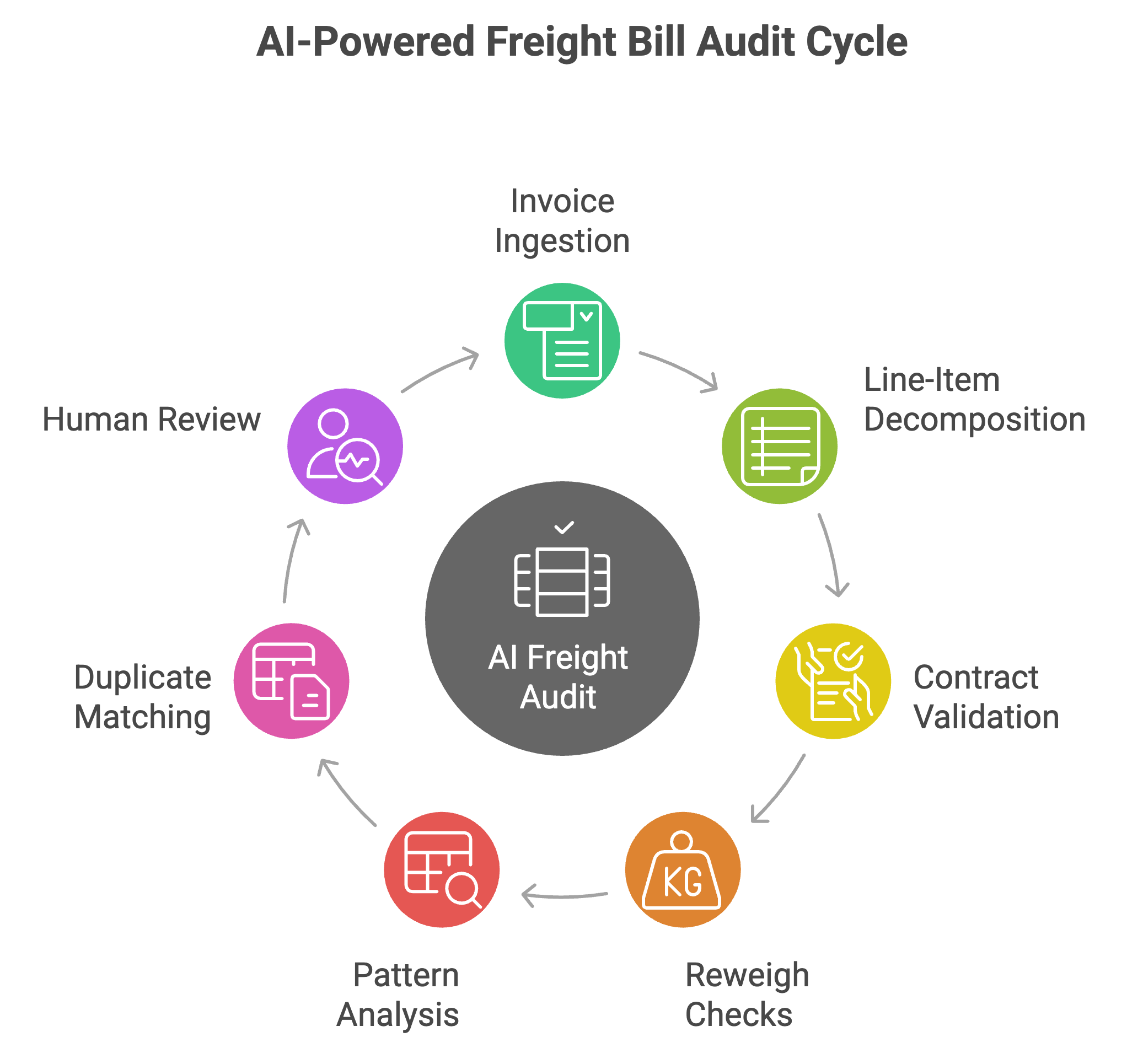
Here’s how that process works in practice.
1. Continuous Invoice Ingestion (No Batching)
Freight invoices arrive in many forms—PDFs, EDI feeds, carrier portals, balance-due notices, and reweigh statements.
The AI agent ingests invoices as they arrive, regardless of format, instead of waiting for weekly or monthly batches. This ensures issues are identified immediately, not weeks later when context is lost and AP has already moved on.
2. Line-Item Decomposition
Rather than treating invoices as totals, the AI breaks each bill into structured components, including:
- Base transportation charges
- Rate base and discount logic
- Fuel surcharge calculations
- Individual accessorials
- Minimum charges
- Reweigh and reclassification adjustments
This creates a clean, normalized representation of every charge—something manual audits rarely achieve consistently.
3. Contract/Quote Validation
Each line item is then validated against the agreed commercial logic, including:
- Contracted or Quoted rates and discounts
- Fuel surcharge schedules
- Location-based accessorial rules
- Bundled vs. standalone accessorial agreements
- Service-level commitments
Anything that falls outside expected behavior is flagged automatically—before payment approval.
4. Intelligent Reweigh & Reclass Checks
Reweighs and inspections are a major source of silent overbilling.
The AI recalculates density using available shipment data and checks whether a change in weight should also result in a change in freight class. If weight increases but density improves, the system flags cases where class should decrease but doesn’t.
This removes reliance on manual density math and tribal knowledge.
5. Accessorial Pattern Analysis
Instead of reviewing accessorials one invoice at a time, the AI looks for patterns across shipments, lanes, and carriers.
Examples include:
- Liftgate charges appearing at dock-equipped locations
- Limited-access fees applied inconsistently
- Detention charges concentrated with specific carriers
- Inside delivery fees appearing where not required
This elevates auditing from invoice review to behavioral insight.
6. Duplicate and Balance-Due Matching
Late adjustments and duplicate invoices are automatically compared against original shipments.
The AI links:
- Original invoice
- Balance-due invoice
- Supporting documentation (if present)
Any unsupported delta is flagged instantly, preventing blind payment of follow-on charges.
7. Exception-Only Human Review
Instead of humans reviewing every invoice, the AI routes only true anomalies for review.
This allows teams to:
- Focus on edge cases
- Act quickly while context is fresh
- Maintain consistent review standards at scale
Human judgment is preserved—just applied where it actually matters.
Example — density-class corrections LTL
A logistics management firm noticed recurring reweighs from a national carrier.
The AI Agent flagged a mathematical oversight:
Even with the increased weight, density meant the class should go down, not up.
The carrier adjusted the weight — but never adjusted class.
Manual review would have paid it.
AI caught it.
That isn’t a dispute story — it’s prevented leakage.
Free Session with Our Head of AI
30-Minute, no-strings-attached brainstorming session to identify potential bottlenecks and explore how AI can solve your business challenge.
Book Now →.png)
Efficiency Means Capacity Expansion, Not Staff Expansion
Scaling freight-management revenue has historically meant scaling headcount — analysts, billing staff, exception teams.
That model doesn’t work anymore.
AI pre-validation creates:
- daily invoice flows instead of weekly batching
- exception routing instead of general review
- faster approvals instead of AP bottlenecks
- predictable SLAs instead of heroic effort
Example — onboarding enterprise freight
A logistics firm supporting retail distribution evaluated a national contract that would add ~15,000 LTL invoices per month.
Without automation, onboarding required four new billing analysts.
With AI pre-validation and exception routing, onboarding required zero new hires — and invoices closed in two-day cycles.
Capacity became a revenue unlock — not a cost burden.
Cost Control Moves From Refund Chasing to Leakage Prevention
Refund recovery is a comfort metric — it makes everyone feel smart.
But recovery means cash already left.
Modern clients want:
Don’t lose the money to begin with.
An AI audit layer turns preventive economics into a deliverable:
- overcharges flagged before approval
- duplicate invoices blocked
- carrier behavior tracked
- accessorial creep isolated
- analyst blind spots eliminated
Example — controlling balance-due surprises
A logistics firm saw balance-due invoices from a carrier ~45 days post-delivery.
Before automation, those quietly entered AP because memory fades.
After automation, the AI compared carrier balance-due requests to original files — and instantly flagged mismatches.
That isn’t recovery.
That’s cash protection.
The Agent Fits Beside Existing Tools — Not Instead of Them
Most logistics-management companies run a messy ecosystem:
- ERPs for customer finance
- Freight-payment tools
- TMS platforms across carrier modes
- Parcel auditing portals
- Manual spreadsheets tracking rules
You can’t fix that by ripping everything out.
You fix it by adding a cognitive layer.
The AI Agent:
- ingests data from all systems
- normalizes charge logic
- applies verification consistently
- pushes results back into current workflows
Billing stays where it is.
Validation becomes scalable.
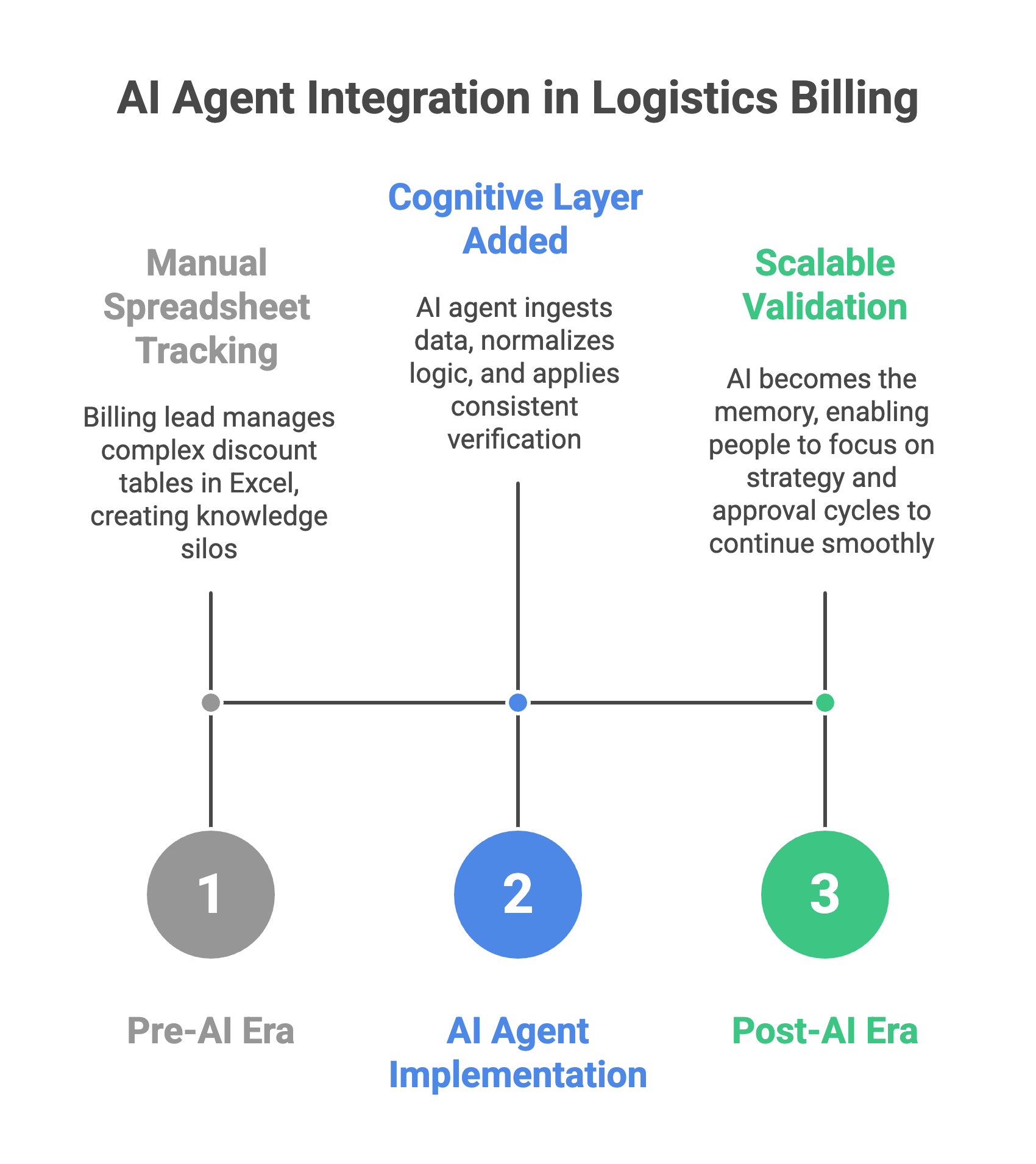
Example — eliminating spreadsheet tribal knowledge
A billing lead tracked 11 different discount tables in Excel — unique to each client and carrier.
When she went on leave, approval cycles stalled.
When she resigned, accuracy disappeared.
AI becomes the memory.
People become strategists.
Who Benefits Most
This model fits organizations that operate between shippers and carriers:
- freight-management companies
- transportation cost-control firms
- outsourced logistics service providers
- procurement outsourcing groups
- hybrid logistics-plus-technology platforms
These firms compete on:
- financial credibility
- cost governance
- carrier accountability
- renewal justification
- margin defense
Invoice accuracy isn’t clerical.
It’s a commercial advantage.
Real World - AI Driven Freight Bill Audit Examples
1. Discount Applied Incorrectly
An AI audit flagged shipments where the correct discount percentage was applied to the base rate—but not to accessorial charges that were contractually included.
Manual review had missed the discrepancy because the total “looked reasonable.”
The AI prevented payment at the incorrect rate before AP approval.
2. Fuel Surcharge Drift
Fuel surcharge tables change frequently and vary by carrier.
The AI detected a mismatch between the billed fuel percentage and the correct index for that shipment week. Instead of identifying this weeks later through reconciliation, the error was caught immediately and corrected upstream.
3. Reweigh Without Proper Class Adjustment
A carrier increased shipment weight after inspection but left the freight class unchanged.
The AI recalculated density and flagged the inconsistency automatically. The issue was resolved before payment—without relying on anyone to manually re-check class tables.
4. Unnecessary Liftgate Charges
Across multiple shipments to the same destination, the AI detected repeated liftgate charges at a facility known to have a dock.
While each individual charge was small, the pattern revealed systematic overbilling that would have gone unnoticed through sampling.
5. Late Balance-Due Invoice
A balance-due invoice arrived weeks after delivery with additional detention charges.
The AI matched it to the original shipment, checked available documentation, and flagged the charge as unsupported—stopping it from entering AP without context.
The Bottom Line: Accuracy Is a Retention Strategy
Freight-management firms don’t lose clients because a pallet showed up late.
They lose clients because the invoicing didn’t stand up to scrutiny.
Free Session with Our Head of AI
30-Minute, no-strings-attached brainstorming session to identify potential bottlenecks and explore how AI can solve your business challenge.
Book Now →
An AI Audit Agent protects:
- trust
- financial accuracy
- analyst bandwidth
- onboarding capacity
- renewal strength
It doesn’t replace people.
It removes the arithmetic that prevents people from thinking.
And it lets a logistics management company say the line every CFO wants to hear:
“We validate 100% of freight invoices before they ever become cost.”
That’s not backend hygiene — it’s the new competitive moat.
Our team helps high-volume logistics organizations reduce execution errors and prevent billing leakage using AI.
If AI implementation is on your radar this year, check out how we can help and other high ROI use cases and case studies here: https://symphonize.com/logistics-ai


.png)


.png)


Christian Financial Credit Union
Huntington National Bank
Paqqets
Meridian Medical Management
Thales Group
Meridian Medical Management