


When enterprise leaders talk about AI adoption, voice often gets lumped into the same category as chatbots, task agents, or workflow automation. On the surface, that seems reasonable—after all, they all rely on similar underlying models.
In practice, this assumption is one of the main reasons Voice AI initiatives struggle.
Voice AI is not “chat AI with speech.” It is a fundamentally different class of AI investment, with different risk profiles, different operational implications, and far less tolerance for error. Evaluating it using the same mental models applied to chatbots or internal AI tools almost always leads to unrealistic expectations.
Before discussing where Voice AI fits, what it should automate, or how much it costs, it’s important to understand why it behaves differently.
Why Voice AI Is a Fundamentally Different Class of AI Investment
Voice is the most human, most time-sensitive, and most unforgiving interface an enterprise operates. When something goes wrong in chat, users tolerate retries. When something goes wrong on a call, trust collapses immediately.
That’s why voice has remained stubbornly expensive even as other channels modernized.
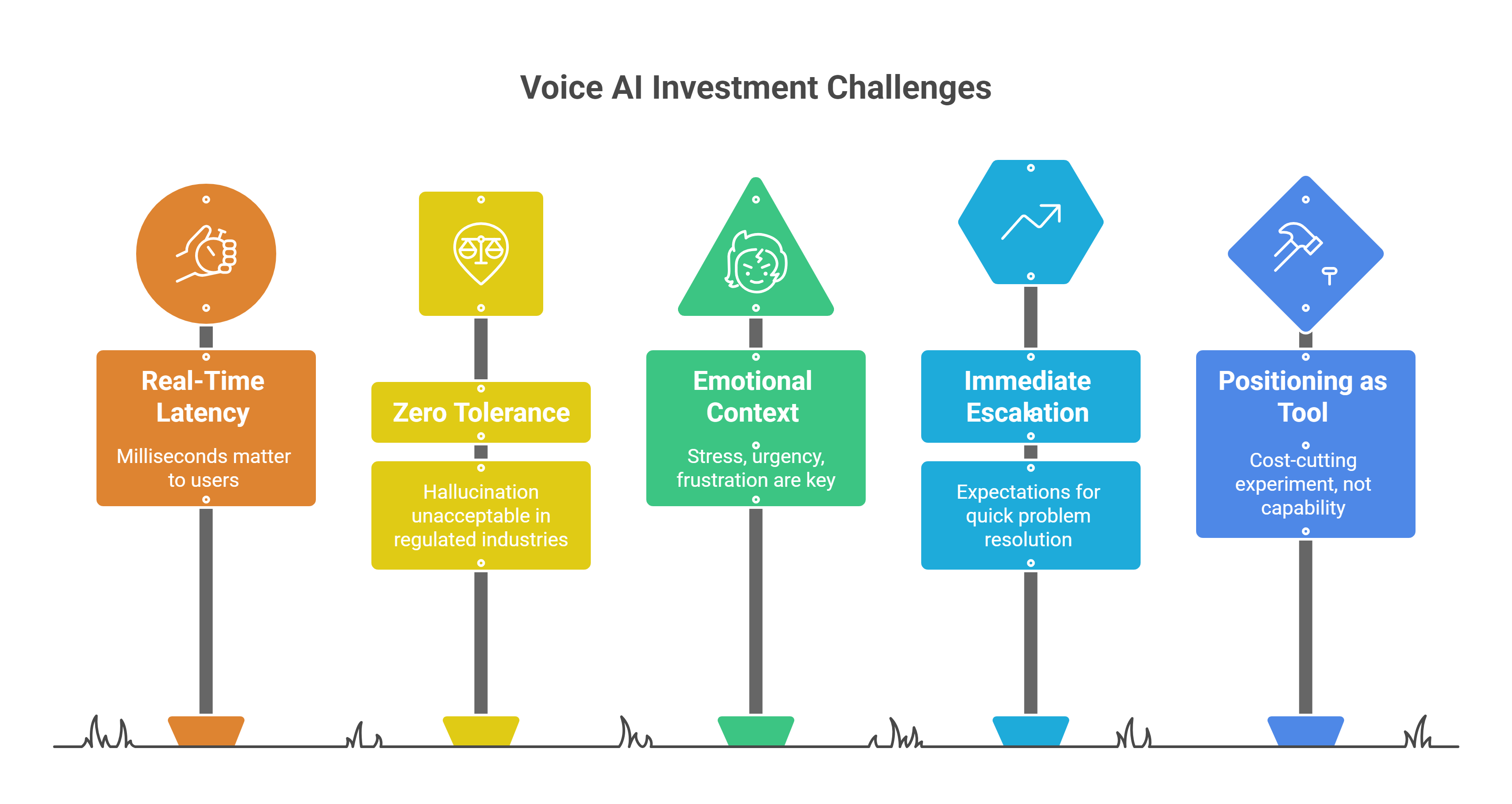
Voice AI is not just “chat AI with a microphone.” It introduces constraints that most AI systems never face:
- Real-time latency (milliseconds matter)
- Zero tolerance for hallucination in regulated industries
- Emotional context (stress, urgency, frustration)
- Immediate escalation expectations
This is also why Voice AI adoption has lagged — and why, now that it is viable, it has become a board-level topic.
This creates a zero-forgiveness interface. The system is judged in real time, and there is no buffer between model behavior and user perception.
That single constraint—real-time, exposed interaction—puts Voice AI in a different category than most AI deployments enterprises are familiar with.
One of the biggest reasons Voice AI initiatives struggle is not technology — it’s positioning.
Voice AI is often introduced as a tool: a smarter IVR, a cost-cutting experiment, or an “AI agent” meant to replace people. None of those framings hold up in practice. Voice AI succeeds only when it is treated as an operating capability with clearly defined ownership.
Before asking what Voice AI can do, leaders need to decide what role it should play inside the organization.
Where Voice AI Actually Belongs in the Enterprise
One of the biggest reasons Voice AI initiatives struggle is not technology — it’s positioning.
Voice AI is often introduced as a tool: a smarter IVR, a cost-cutting experiment, or an “AI agent” meant to replace people. None of those framings hold up in practice. Voice AI succeeds only when it is treated as an operating capability with clearly defined ownership.
Before asking what Voice AI can do, leaders need to decide what role it should play inside the organization.
1. Voice AI vs Human Agents
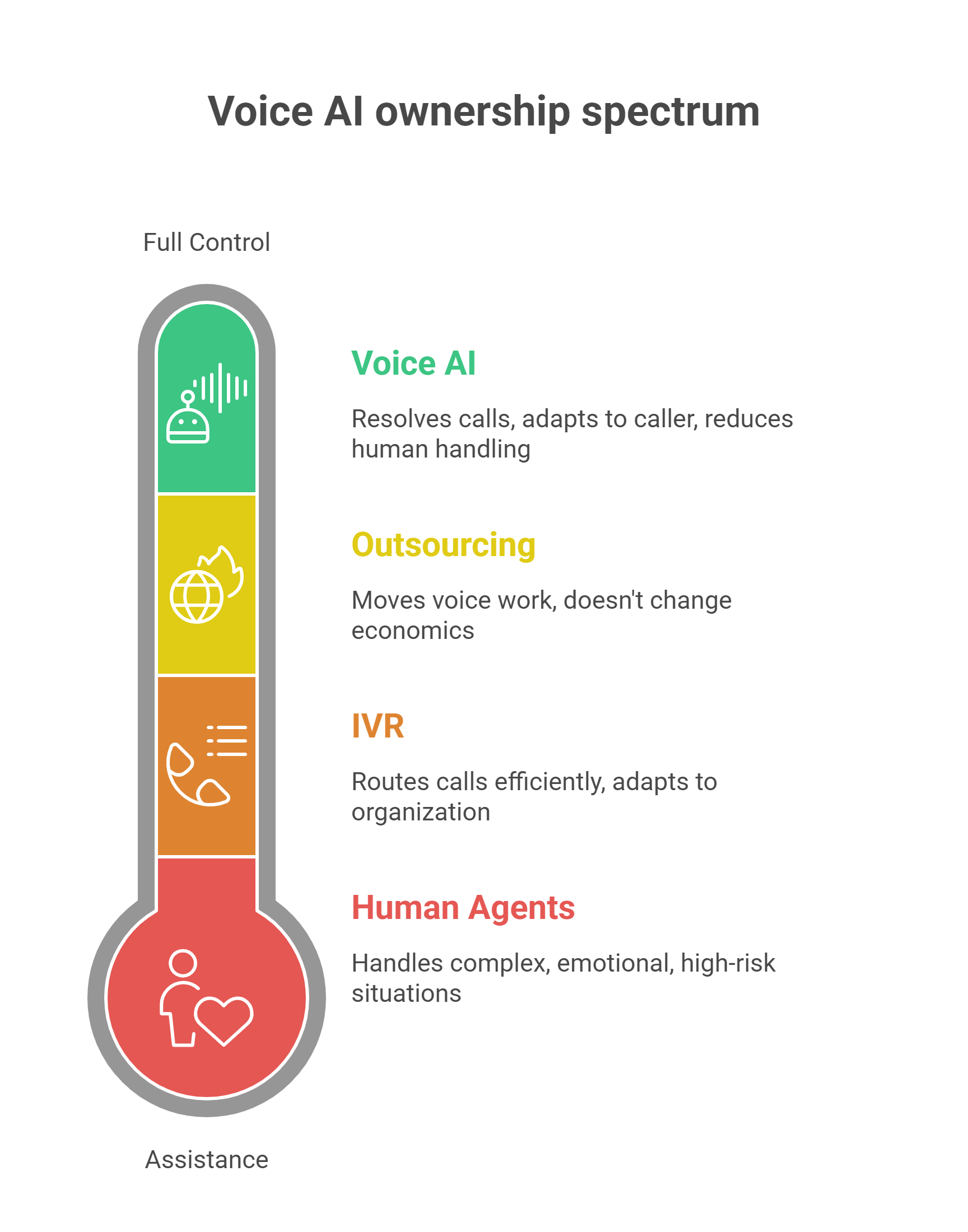
Voice AI should not be framed as a replacement for human agents. It is far more effective as a capacity layer.
Voice AI works best when it owns:
- High-volume, repetitive interactions
- Predictable workflows
- Standard information requests
- After-hours and overflow demand
Human agents should remain responsible for:
- Emotionally charged conversations
- Judgment-heavy decisions
- Negotiation and exception handling
- Situations where trust matters more than speed
When Voice AI absorbs noise, human agents spend more time on work that actually requires human judgment. Organizations that frame Voice AI as “agent replacement” often face resistance and poor adoption. Those that frame it as agent leverage see better outcomes.
2. Voice AI vs IVR
IVR systems are designed to route calls efficiently. Voice AI is designed to resolve them.
The difference is subtle but critical.
IVR asks the caller to adapt to the organization:
- Press keys
- Navigate menus
- Guess which option fits their problem
Voice AI adapts to the caller:
- Interprets intent
- Asks clarifying questions
- Attempts resolution before escalation
IVR optimizes internal efficiency.
Voice AI optimizes end-to-end resolution.
Treating Voice AI as a “better IVR” limits its value and recreates the same frustrations with a new interface.
3. Voice AI vs Outsourcing
Outsourcing moves voice work to a different labor pool. It does not change the underlying economics.
Voice AI changes the equation by:
- Reducing the number of calls that require human handling
- Smoothing demand spikes
- Extending availability without adding headcount
In this sense, Voice AI is not a staffing strategy — it is a capacity strategy.
Free Session with Our Head of AI
30-Minute, no-strings-attached brainstorming session to identify potential bottlenecks and explore how AI can solve your business challenge.
Book Now →.png)
4. What Voice AI Should Own End-to-End
Voice AI performs best when it fully owns:
- Clearly defined call categories
- Low-ambiguity workflows
- Tasks with measurable success criteria
- Interactions where escalation rules are explicit
Partial ownership creates confusion and failure. Voice AI should either own a call type or assist — not sit awkwardly in between.
5. What Should Never Be Automated (At Least Initially)
Certain interactions should remain human-led:
- Highly emotional disputes
- Complex negotiations
- Situations with significant legal or financial risk
- Conversations where empathy outweighs efficiency
Automating these too early damages trust and slows adoption.
6. The Role Voice AI Plays in the Organization
When positioned correctly, Voice AI is:
- A first-line resolution layer
- A pressure-release valve for agents
- A consistency engine across voice interactions
It is not a silver bullet.
It is an operating capability that must be deliberately assigned boundaries.
That clarity is what separates scalable Voice AI programs from expensive experiments.
Core Voice AI Use Cases (Where It Actually Works)
Not every interaction that happens over the phone should be automated. Enterprises that treat Voice AI as a universal replacement for human agents usually fail early. The organizations that succeed are far more selective.
The most effective Voice AI programs start with use cases where voice is the natural interface, volume is high, and outcomes are measurable.
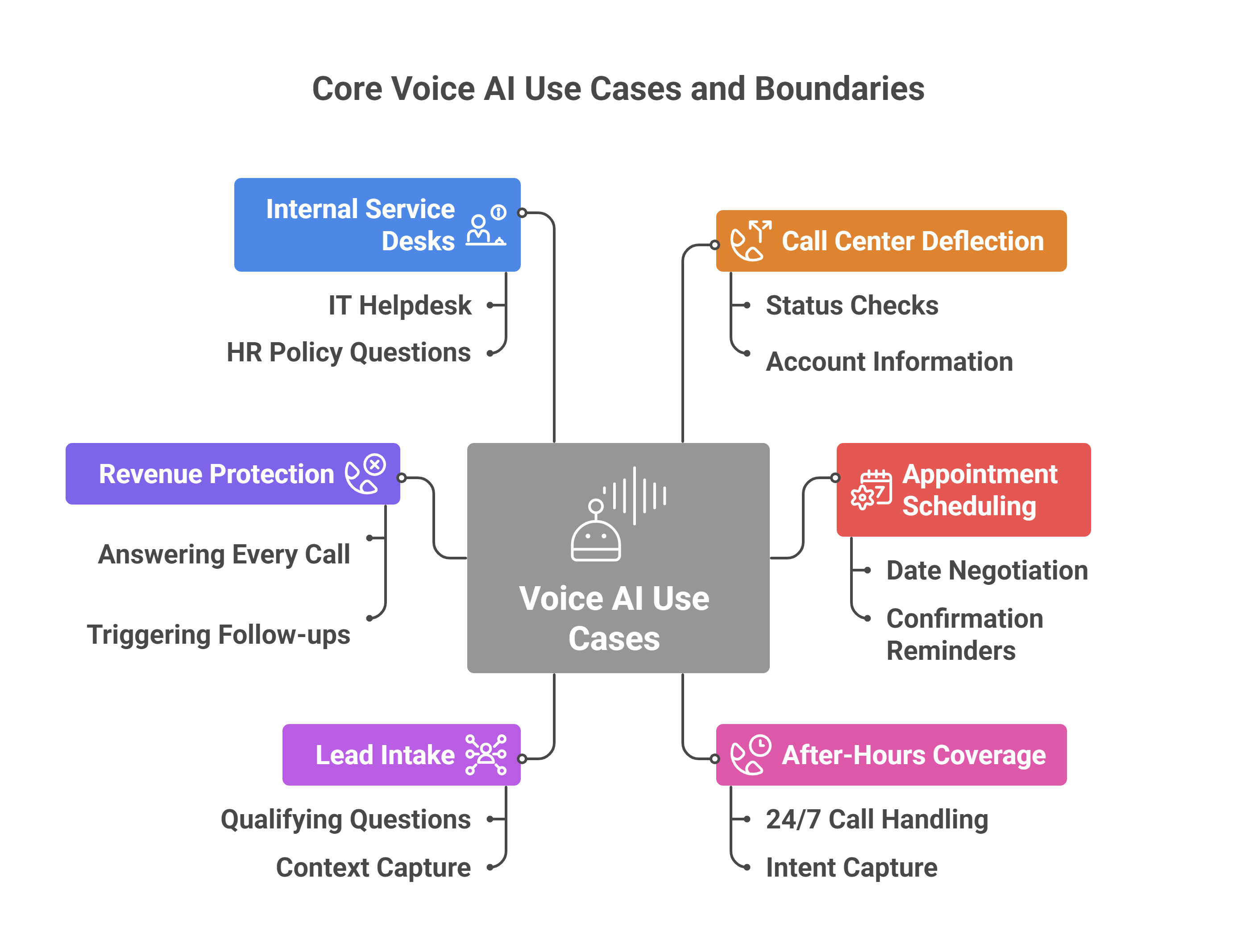
Below are the core use cases where Voice AI consistently delivers value — and the boundaries where it breaks down.
1. Call Center Deflection
When customers call, it’s usually because they want an answer now. For many issues, opening a chat window or navigating a portal feels slower than speaking.
Voice AI works well for:
- Status checks
- Account or order information
- Policy explanations
- Basic troubleshooting
Where enterprises see value
- Immediate reduction in call volume
- Lower agent load during peak hours
- More consistent answers than human agents under pressure
Where it fails
- When answers require judgment or negotiation
- When backend data is inconsistent or unreliable
- When escalation paths are unclear
Voice AI should fully own these call types or not handle them at all. Partial deflection often creates more frustration than relief.
2. Appointment Scheduling and Rescheduling
Why voice (not chat)
Scheduling is conversational by nature. People think aloud, change their minds mid-sentence, and often call because of urgency.
Voice AI handles:
- Date and time negotiation
- Constraint changes (“actually, next week works better”)
- Confirmation and reminders
Where enterprises see value
- Reduced agent time spent on repetitive scheduling tasks
- Higher completion rates compared to chat
- Fewer abandoned interactions
Where it fails
- When scheduling rules are overly complex
- When availability data isn’t real-time
- When exceptions aren’t handled cleanly
Healthcare, financial services, and field service organizations see particularly strong returns here.
Free Session with Our Head of AI
30-Minute, no-strings-attached brainstorming session to identify potential bottlenecks and explore how AI can solve your business challenge.
Book Now →
3. After-Hours Coverage
Why voice (not chat)
Customers don’t stop calling when offices close. In many industries, missed calls equal missed revenue.
Voice AI enables:
- 24/7 call handling
- Intent capture
- Follow-up triggers without staffing overnight teams
Where enterprises see value
- Revenue protection
- Improved customer experience outside business hours
- Reduced reliance on voicemail
Where it fails
- When callers expect immediate resolution for complex issues
- When follow-up workflows aren’t reliable
After-hours Voice AI works best when expectations are set clearly.
4. Lead Intake and Qualification
Why voice (not chat)
Inbound leads often prefer speaking to someone — especially for high-value or urgent needs.
Voice AI can:
- Ask structured qualifying questions
- Capture context
- Route only serious prospects to sales teams
Where enterprises see value
- Reduced wasted time for sales teams
- Faster response to inbound demand
- Better prioritization of leads
Where it fails
- When qualification criteria are vague
- When the handoff to humans lacks context
This use case works when Voice AI prepares the conversation, not replaces it.
5. Revenue Protection (Missed Calls)
Why voice (not chat)
Missed calls represent silent revenue loss. Many organizations underestimate this impact.
Voice AI helps by:
- Answering every call
- Capturing intent
- Triggering follow-ups automatically
Where enterprises see value
- Higher conversion rates
- Reduced leakage from unanswered calls
- Clear attribution of recovered revenue
Where it fails
- When follow-up actions aren’t executed reliably
- When intent capture is too generic
This use case often pays for itself quickly.
6. Internal Service Desks
Why voice (not chat)
Employees are often mobile, multitasking, or working hands-free. Voice is simply faster.
Voice AI supports:
- IT helpdesk requests
- HR policy questions
- Internal task initiation
Where enterprises see value
- Reduced ticket volume
- Faster resolution
- Less friction for employees
Where it fails
- When internal systems are fragmented
- When policies change frequently without updates
The Pattern That Matters
Across all successful use cases, the pattern is consistent:
Voice AI works best when:
- The interaction is time-sensitive
- The workflow is predictable
- Success criteria are clear
- Escalation rules are explicit
It fails when ambiguity, emotion, or judgment dominate.
This clarity is what grounds Voice AI in business reality — and prevents expensive experimentation.
Free Session with Our Head of AI
30-Minute, no-strings-attached brainstorming session to identify potential bottlenecks and explore how AI can solve your business challenge.
Book Now →
Voice AI Capability Tiers (Levels of Ownership)
Once organizations are clear on where Voice AI fits and which use cases make sense, the next question naturally follows:
How much responsibility should we actually give Voice AI?
This is where capability tiers matter — but not in the way they are usually discussed.
Most conversations frame tiers in terms of price or technology sophistication. In practice, what separates one tier from another is ownership. Each tier represents how much of the interaction Voice AI is trusted to own end-to-end, and how much risk the organization is willing to absorb.
%20-%20visual%20selection.png)
Understanding tiers as ownership levels helps leaders choose systems that match readiness — rather than over-engineering or under-scoping from the start.
Tier 1: Routing and Information
Ownership: Navigation, not resolution
At this level, Voice AI’s role is limited. It listens, classifies, and routes.
Typical responsibilities include:
- Identifying caller intent at a high level
- Answering static or low-risk informational questions
- Routing calls to the appropriate queue or department
Where this tier fits
- Organizations early in Voice AI adoption
- Use cases where resolution requires a human
- Environments with high compliance sensitivity
Risk profile
- Low operational risk
- Low customer impact when errors occur
- Limited upside in terms of deflection or cost reduction
This tier is often a safer starting point — but it should not be mistaken for transformation.
Tier 2: Task Completion
Ownership: Single-step actions within guardrails
Tier 2 introduces action, not just routing.
Here, Voice AI can:
- Schedule or reschedule appointments
- Capture leads or service requests
- Perform simple updates or lookups
- Complete well-defined tasks with clear success criteria
Where this tier fits
- Organizations comfortable with limited automation
- High-volume, repetitive workflows
- Teams ready to define guardrails and escalation rules
Risk profile
- Moderate operational risk
- Errors are recoverable if escalation paths are clear
- Higher customer impact than Tier 1
Tier 2 is often where enterprises start seeing tangible value — and where governance begins to matter.
Tier 3: Policy-Aware Resolution
Ownership: Resolving defined call categories
Tier 3 is where Voice AI becomes operationally meaningful.
At this level, Voice AI:
- Accesses internal knowledge and policies
- Integrates with core systems (CRM, ticketing, scheduling)
- Makes decisions within defined policy boundaries
- Escalates intelligently when confidence drops
Where this tier fits
- Organizations with structured processes
- Regulated industries with clear rules
- Teams ready for cross-functional ownership
Risk profile
- Higher operational and compliance risk
- Requires monitoring, QA, and human-in-the-loop design
- Delivers the highest sustainable value for most enterprises
This is the tier where Voice AI shifts from “automation experiment” to business capability.
Tier 4: End-to-End Ownership
Ownership: Entire call categories
At the highest level, Voice AI owns complete interaction types from start to finish.
This includes:
- Multi-step workflows
- Decision-making across systems
- Coordination between specialized agents
- Full accountability for outcomes
Where this tier fits
- Mature organizations with strong governance
- High-volume, well-understood call categories
- Leadership alignment across IT, operations, and CX
Risk profile
- High visibility and high impact
- Errors affect customers directly
- Requires disciplined design and oversight
Tier 4 is powerful — but not appropriate for every organization or use case.
Free Session with Our Head of AI
30-Minute, no-strings-attached brainstorming session to identify potential bottlenecks and explore how AI can solve your business challenge.
Book Now →
Choosing the Right Tier
The most common mistake is assuming higher tiers are inherently better.
In reality:
- Too low a tier limits value
- Too high a tier increases risk prematurely
The right question is not “What’s the most advanced Voice AI we can build?”
It’s:
“What level of ownership are we ready to assign — operationally and culturally?”
Answering that honestly is what keeps Voice AI initiatives grounded and scalable.
Architecture That Makes or Breaks Voice AI
Most Voice AI failures are blamed on models.
In reality, models are rarely the problem.
Enterprises don’t struggle with Voice AI because speech recognition is inaccurate or language models are incapable. They struggle because Voice AI is a systems problem, and systems fail when they are stitched together without architectural discipline.
This is the point where many pilots break down — and where experienced software services teams make the difference.
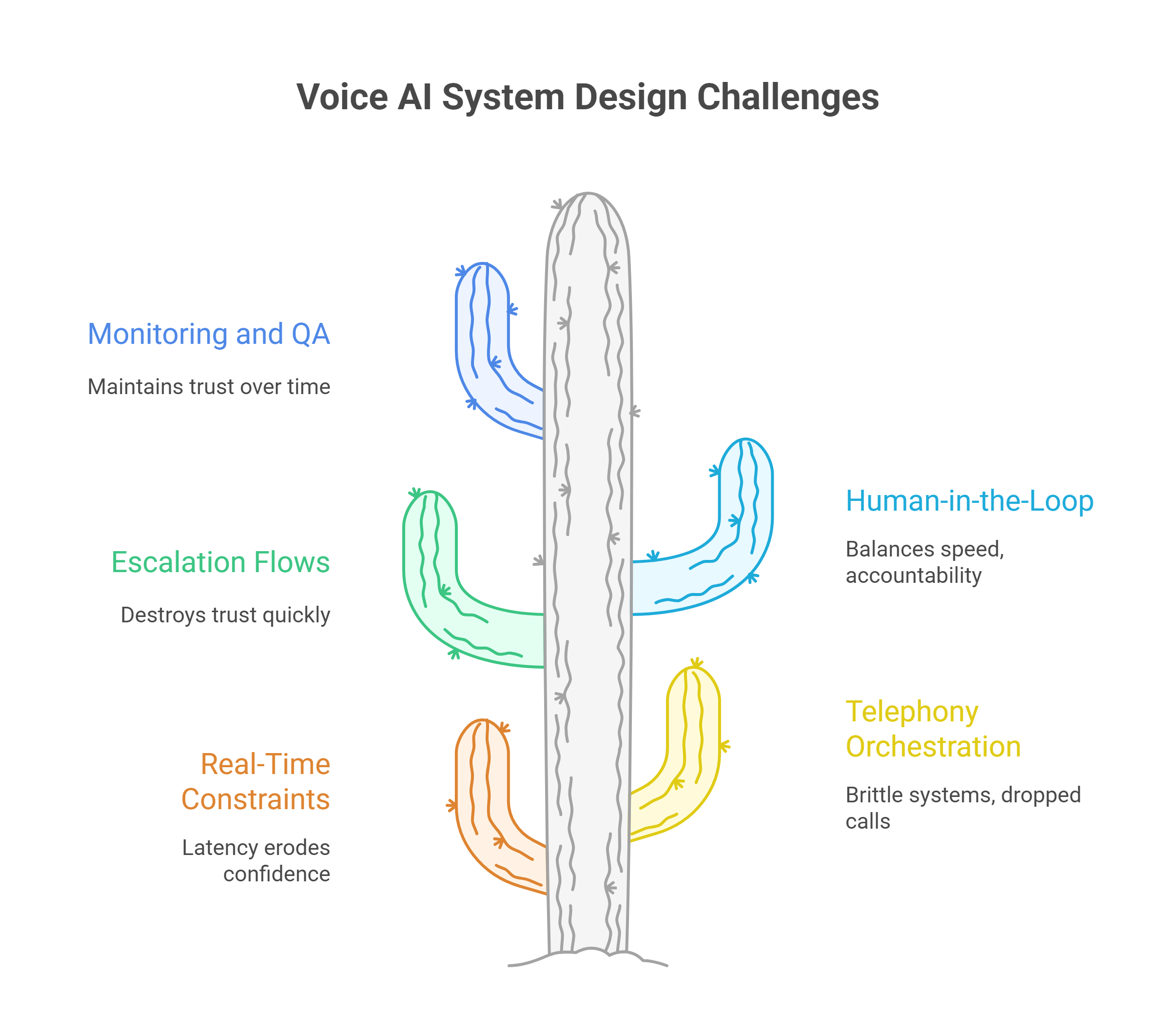
1. Real-Time Constraints Are Non-Negotiable
Voice is unforgiving of delay.
In a live call:
- A few hundred milliseconds of latency is noticeable
- Silence feels like failure
- Delayed responses erode confidence quickly
This means Voice AI cannot rely on loosely coupled, slow-moving pipelines. Every component — speech recognition, intent reasoning, backend calls, and response generation — must be orchestrated with real-time guarantees.
Architectures designed for batch processing or chat-based systems rarely hold up under these constraints. Voice AI requires intentional design for concurrency, fallback, and timeouts.
2. Telephony and AI Must Be Orchestrated as One System
A common mistake is treating telephony as plumbing and AI as an add-on.
In reality, telephony events drive the entire interaction:
- Call pickup
- Silence detection
- Interruptions
- DTMF inputs
- Call transfers and terminations
Voice AI must react to these events instantly. That requires tight orchestration between telephony platforms and AI services — not asynchronous handoffs.
When this layer is weak, systems feel brittle: calls drop, responses lag, or context is lost during transfers.
3. Escalation Flows Are a Core Feature, Not a Fallback
Escalation is often treated as an exception.
In Voice AI, escalation is part of the happy path.
Reliable systems:
- Define confidence thresholds explicitly
- Know when to stop trying
- Transfer calls with full context
- Avoid forcing callers to repeat themselves
Poorly designed escalation is one of the fastest ways to destroy trust. Voice AI must hand off gracefully, not reluctantly.
4. Human-in-the-Loop Is About Trust, Not Control
Human-in-the-loop design is not a sign of weak automation. It is a sign of mature systems.
Effective Voice AI architectures:
- Allow humans to review or override decisions
- Capture feedback for continuous improvement
- Support selective approval based on risk
This approach balances speed with accountability — especially in regulated environments where blind automation is unacceptable.
5. Monitoring and QA Are Ongoing, Not Optional
Unlike chat systems, Voice AI failures are public and immediate.
Production-grade systems require:
- Call-level monitoring
- Conversation reviews
- Drift detection
- Performance metrics tied to business outcomes
Voice AI must be treated as a living system, not a one-time deployment. Monitoring and QA are how trust is maintained over time.
Free Session with Our Head of AI
30-Minute, no-strings-attached brainstorming session to identify potential bottlenecks and explore how AI can solve your business challenge.
Book Now →
Why Architecture Determines Outcomes
The uncomfortable truth is this:
Most Voice AI projects fail not because of AI limitations, but because of weak system design.
Voice AI rewards teams that think in systems, not tools.
This is why software services experience matters. It’s not about choosing the “best” model — it’s about building an architecture that can survive real-world usage, scale under pressure, and recover gracefully when things go wrong.
That architecture is what separates pilots from production.
Cost of Voice AI: What Enterprises Actually Pay — and Why
By the time organizations reach this question, they’ve usually moved past curiosity.
They understand where Voice AI fits, which use cases make sense, and what level of ownership they’re willing to assign. Only then does the cost conversation become meaningful.

When leaders ask, “Why does Voice AI cost more than chat AI?”, the answer is not complexity for complexity’s sake. It’s a direct consequence of the operational realities we’ve already discussed.
1. Why Voice AI Costs More Than Chat AI
Voice AI is fundamentally more expensive because it operates under constraints that chat systems simply don’t have.
Voice systems must handle:
- Real-time concurrency (many calls at once)
- Telephony infrastructure layered on top of AI services
- Low-latency orchestration across multiple components
- Higher reliability expectations from users
- Recording, logging, and compliance requirements in many industries
Chat systems can queue, retry, or fail quietly.
Voice systems must respond immediately — or escalate cleanly.
That difference alone drives both build and operating costs higher.
2. Typical Enterprise Build Ranges
While every deployment is different, most enterprise Voice AI systems fall into predictable ranges when scoped responsibly.
- Basic to mid-level Voice AI
Routing, simple task completion, limited integrations
$20K–$60K to build - Enterprise-grade Voice AI
Policy-aware resolution, system integrations, human-in-the-loop
$60K–$120K to build - Advanced end-to-end ownership systems
Multi-step workflows, multiple agents, deep orchestration
$120K–$250K+
The key variable is not features — it’s how much responsibility the system owns.
3. Ongoing Costs Leaders Often Underestimate
The build is only part of the equation.
Ongoing costs typically include:
- Telephony usage and concurrency scaling
- AI inference and speech processing
- Monitoring, QA, and tuning
- Compliance and audit support
- Continuous improvement as language and policies change
For most enterprise deployments, ongoing costs scale with:
- Call volume
- Reliability expectations
- Governance requirements
This is why “cheap” Voice AI often becomes expensive over time.
4. Why Cheap Voice AI Fails in Production
Low-cost Voice AI solutions usually cut corners in places that aren’t visible during demos.
Common failure points include:
- Poor escalation handling that floods agents
- Latency under real call volume
- Lack of monitoring and QA
- Fragile integrations that break silently
- No feedback loop for improvement
The result is predictable:
- Customer frustration
- Agent distrust
- Low adoption
- Eventual abandonment
Cheap Voice AI doesn’t fail because it’s inaccurate.
It fails because it’s operationally brittle.
5. The Cost Question That Actually Matters
The real question is not:
“What’s the cheapest Voice AI we can deploy?”
It’s:
“What level of Voice AI ownership can we support — and what return does that unlock?”
When Voice AI is scoped correctly:
- It reduces cost-to-serve
- Protects revenue from missed calls
- Improves agent effectiveness
- Scales capacity without linear headcount growth
At that point, cost stops being the headline — and becomes an investment decision.
Free Session with Our Head of AI
30-Minute, no-strings-attached brainstorming session to identify potential bottlenecks and explore how AI can solve your business challenge.
Book Now →
How Enterprises Acquire Voice AI Capability - Build vs Buy vs Managed Service
Once an organization is clear on where Voice AI belongs, which use cases make sense, and what level of ownership it is ready to assign, the next question becomes practical:
How do we actually acquire this capability?
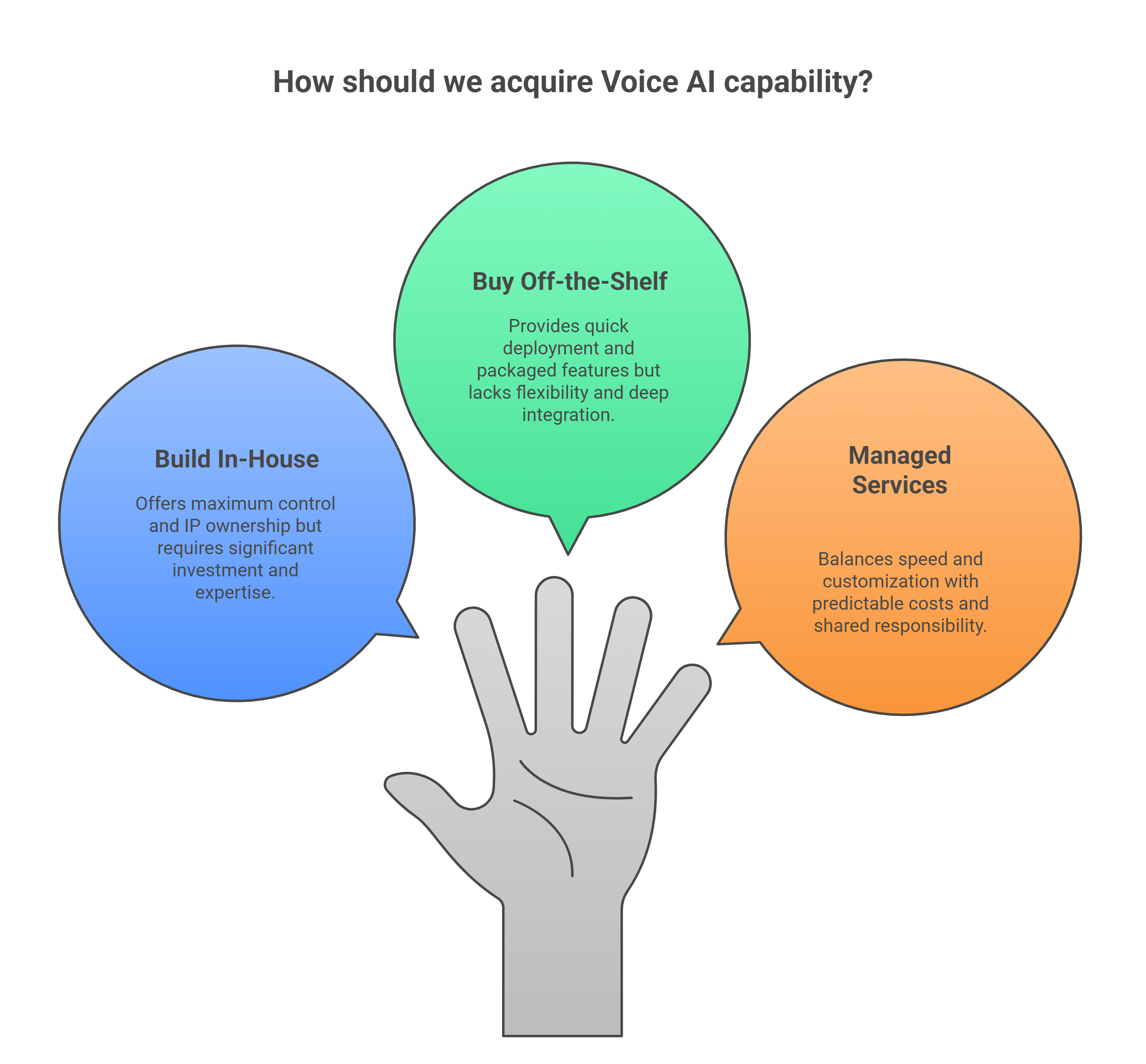
In most enterprises, there are three viable paths: building in-house, buying off-the-shelf solutions, or partnering through a managed service model. Each path has trade-offs that extend far beyond cost.
1. Building Voice AI In-House
Building internally gives organizations the highest degree of control.
In this model, internal teams design the architecture, select vendors and models, integrate systems, and operate the Voice AI platform over time.
Where this approach fits
- Voice AI is core intellectual property
- The organization has deep AI, telephony, and platform engineering expertise
- Leadership is prepared for a long investment horizon
What organizations underestimate
- Specialized talent is hard to hire and retain
- Voice AI requires ongoing operations, not just development
- Time-to-value is often 9–12 months or more
- Internal teams carry the full burden of reliability and compliance
Building can be the right choice — but only when Voice AI is strategic enough to justify permanent internal ownership.
2. Buying Off-the-Shelf Solutions
Buying pre-built Voice AI platforms is attractive because it promises speed.
These solutions typically offer:
- Quick deployment
- Packaged features
- Vendor-managed updates
Where this approach fits
- Commodity use cases
- Limited need for differentiation
- Organizations testing Voice AI with minimal risk
What organizations encounter in practice
- Limited flexibility once workflows become complex
- Difficulty integrating deeply with internal systems
- Pricing that scales sharply with usage
- Dependence on vendor roadmaps and constraints
Buying works best when Voice AI is an accessory — not a core operating capability.
3. Managed Voice AI Services
Managed services sit between building and buying.
In this model, a partner designs, deploys, and operates Voice AI systems tailored to the organization’s workflows, while the enterprise retains strategic oversight.
Where this approach fits
- Organizations that want speed without sacrificing customization
- Teams that don’t want to build or retain specialized AI talent
- Enterprises that view Voice AI as important, but not core IP
Why this model is gaining traction
- Faster time-to-value than building
- More flexibility than off-the-shelf tools
- Predictable operating costs
- Shared responsibility for reliability and improvement
Managed services work best when Voice AI is treated as a long-term capability, not a one-off project.
The Strategic Choice Behind the Choice
The real decision is not build vs buy vs managed.
It is:
- How central Voice AI is to your competitive advantage
- How much operational ownership you want to carry
- How quickly you need results
- How much risk your organization is willing to absorb
Most enterprises don’t fail because they pick the “wrong” option. They fail because they pick an option that doesn’t match their organizational maturity.
Where Symphonize Fits — Naturally
At Symphonize, we’ve found that the managed service model often strikes the right balance for enterprises adopting Voice AI.
It allows organizations to:
- Move quickly
- Avoid brittle, off-the-shelf constraints
- Build production-grade systems
- Scale responsibly over time
Not because it’s the easiest path — but because it aligns capability, ownership, and outcomes.
Free Session with Our Head of AI
30-Minute, no-strings-attached brainstorming session to identify potential bottlenecks and explore how AI can solve your business challenge.
Book Now →
Hidden Risks and Failure Modes in Voice AI
Most Voice AI failures don’t look dramatic at first.
They start as small issues: a call that takes too long to respond, an escalation that feels awkward, an agent who quietly stops trusting the system. Over time, these small cracks compound — until the organization concludes that “Voice AI doesn’t work.”
In reality, it’s not Voice AI that fails.
It’s unaddressed risk.
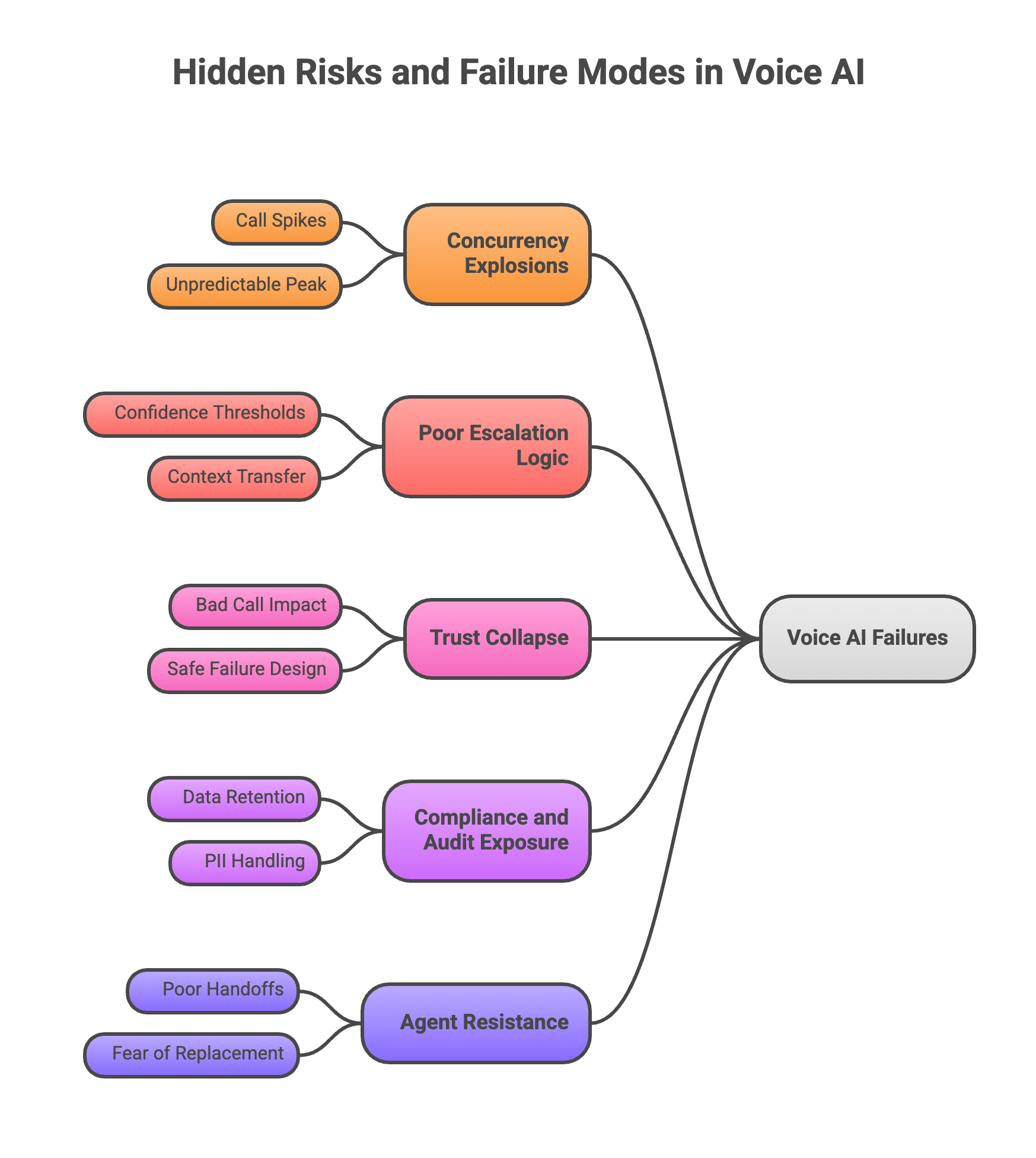
Understanding these failure modes upfront is what separates production systems from expensive pilots.
1. Concurrency Explosions
Voice AI behaves very differently under real traffic than it does in demos.
In production:
- Call spikes happen suddenly
- Peak concurrency is unpredictable
- Latency increases non-linearly under load
Many Voice AI systems work perfectly at low volume — and then degrade catastrophically during peak hours.
When concurrency isn’t designed for explicitly:
- Responses slow down
- Calls drop
- Escalations flood human agents
This creates a vicious cycle where the system adds pressure instead of relieving it.
Concurrency is not an optimization problem.
It is a core architectural requirement.
2. Poor Escalation Logic
Escalation is often treated as an edge case.
In Voice AI, escalation is part of the primary user journey.
When escalation logic is poorly designed:
- Voice AI tries too long to “fix” a problem
- Callers feel trapped
- Agents receive calls with no context
- Customers are forced to repeat themselves
One bad escalation experience can undo weeks of trust-building.
Strong systems define:
- Clear confidence thresholds
- Explicit stop conditions
- Seamless context transfer to humans
Escalation is not a failure — failing to escalate is.
3. Trust Collapse from a Single Bad Call
Voice AI has a trust asymmetry problem.
Users will tolerate:
- Several average experiences
They will not tolerate:
- One clearly wrong or offensive experience
Because voice is personal and immediate, a single bad call can:
- Trigger complaints
- Reach leadership
- Kill adoption internally
This is why “mostly accurate” is not good enough for Voice AI.
The system must be designed to fail safely, not just perform well.
4. Compliance and Audit Exposure
Voice interactions are often regulated by default.
Depending on the industry, this may include:
- Call recording consent
- Data retention policies
- PII handling
- Auditability of decisions
Voice AI systems that are rushed into production often overlook these requirements. The result isn’t just technical debt — it’s legal exposure.
Compliance cannot be bolted on later.
It must be embedded into architecture, logging, and workflows from day one.
5. Agent Resistance and Silent Sabotage
Not all failures are technical.
When human agents don’t trust Voice AI:
- They override it unnecessarily
- They escalate prematurely
- They discourage customers from using it
This resistance is often silent — and devastating.
Agent resistance usually stems from:
- Poor handoffs
- Lack of transparency
- Fear of replacement
- Systems that make their jobs harder
Organizations that succeed treat agents as partners, not endpoints.
Free Session with Our Head of AI
30-Minute, no-strings-attached brainstorming session to identify potential bottlenecks and explore how AI can solve your business challenge.
Book Now →
The Pattern Behind Every Failure
Across all these risks, a single pattern emerges:
Voice AI fails when it is treated as a tool instead of an operating capability.
Concurrency, escalation, trust, compliance, and adoption are not optional considerations. They are the price of operating in real time, at scale, with customers on the line.
The organizations that succeed are not the ones with the flashiest demos.
They are the ones that plan for failure — and design systems that recover gracefully.
The ROI Equation for Voice AI (Costs vs. Enterprise Value)
When I sit down with CEOs and COOs to discuss Voice AI, the first question is almost always the same:
“How much will this cost us?”
It’s a fair question.
But in truth, it’s the wrong place to start.
The better question is:
“What is the return we can expect from this investment — and how do we measure it?”
This shift—from cost-centered thinking to value-centered thinking—is what separates organizations that treat Voice AI as an experiment from those that use it as a durable operating advantage.
Voice AI is not just another automation tool. When deployed correctly, it reshapes how capacity, revenue, risk, and experience are managed across the enterprise.
Why ROI Is the Only Metric That Matters
Technology for technology’s sake doesn’t move the needle.
You don’t invest in Voice AI because:
- It sounds impressive in a demo
- Your competitor announced it
- Vendors promise “AI agents replacing call centers”
You invest in Voice AI because it can do one or more of the following:
- Reduce Costs (Efficiency)
Lower cost-to-serve, reduce peak staffing pressure, deflect repetitive calls - Increase Revenue (Growth)
Capture missed calls, improve conversion, respond faster to high-intent callers - Reduce Risk (Control & Consistency)
Enforce policy, reduce human error, improve auditability and compliance
When I work with leadership teams, I often write a very simple equation on the board:
👉 Voice AI ROI = (Cost Reduction + Revenue Capture + Risk Reduction) ÷ Investment
If you can’t articulate those three components clearly, the project shouldn’t scale yet.
Examples of ROI Model for Voice AI

1. Cost-to-Serve Reduction in a Call Center
Scenario
A mid-sized financial services organization handles a high volume of inbound calls related to balances, payment status, and policy explanations.
- Annual inbound calls: ~120,000
- Average fully loaded cost per human-handled call: ~$7
- Annual voice servicing cost: ~$840,000
Voice AI Investment
- Build cost: ~$60K (policy-aware Voice AI for defined call categories)
- Ongoing costs: ~$6K/month (telephony, AI usage, monitoring)
- Year-one total: ~$132K
Impact
- Voice AI resolves ~55% of inbound calls end-to-end
- Human agents now handle ~54,000 calls
- New annual servicing cost: ~$378,000
ROI Calculation
- Old cost: ~$840,000
- New cost: ~$378,000
- Annual savings: ~$462,000
First-year ROI: ~3.5x
And like most Voice AI systems, ROI improves in year two as build costs disappear and accuracy improves.
2. Revenue Capture from Missed Calls
Scenario
A healthcare provider relies heavily on inbound calls for appointment scheduling. During peak hours and after hours, a meaningful percentage of calls go unanswered.
- Estimated missed calls per month: ~1,200
- Average appointment value: ~$180
Even conservative assumptions showed meaningful leakage.
Voice AI Investment
- Build cost: ~$45K (scheduling + intent capture)
- Ongoing costs: ~$4K/month
- Year-one total: ~$93K
Impact
- Voice AI answers every call
- Schedules when possible
- Captures intent and triggers follow-ups when not
Recovered appointments averaged ~400/month.
ROI Calculation
- Annual recovered revenue: ~400 × $180 × 12 ≈ $864,000
- First-year investment: ~$93K
First-year ROI: ~9x
What’s important here is that Voice AI didn’t “sell better.”
It simply stopped revenue from disappearing.
3. Agent Productivity in Insurance Claims Intake
Scenario
An insurance organization handles first notice of loss calls that require structured data capture before a claim can be processed.
Agents were spending most of their time:
- Asking repetitive questions
- Typing structured data
- Performing low-judgment work
Voice AI Investment
- Build cost: ~$80K (claims intake Voice AI + system integration)
- Ongoing costs: ~$7K/month
- Year-one total: ~$164K
Impact
- Voice AI captures structured claim data upfront
- Agents receive calls with context, not blank screens
- Average handling time drops materially
- Agent throughput increases without burnout
The value didn’t show up as headcount reduction.
It showed up as capacity unlocked and lower attrition risk.
ROI here came from productivity leverage, not layoffs.
4. Risk Reduction in a Regulated Environment
Scenario
A regulated enterprise faced compliance exposure from inconsistent responses across agents.
Voice AI Investment
- Policy-aware Voice AI with mandatory escalation
- Full call logging and audit trails
Impact
- Consistent policy enforcement
- Reduced compliance exceptions
- Faster audits
- Fewer escalations caused by human error
There was no clean “dollar savings” number here.
But leadership was comfortable investing because Voice AI reduced tail risk — the kind that only shows up when something goes wrong.
Free Session with Our Head of AI
30-Minute, no-strings-attached brainstorming session to identify potential bottlenecks and explore how AI can solve your business challenge.
Book Now →
When Voice AI Justifies a Six-Figure Investment
I’m often asked:
“When does it make sense to spend $100K–$200K on Voice AI?”
My answer is consistent:
- When Voice AI can deliver 3–5x value within 12–18 months
- When the use case is high-volume or high-impact
- When missed calls, slow response, or inconsistency are already costing you
- When Voice AI changes capacity, not just cost
If Voice AI can’t realistically create that kind of leverage, the scope is probably wrong — not the technology.
The ROI Shift Leaders Need to Make
The most mature organizations stop asking:
“How much does Voice AI cost?”
And start asking:
“How does Voice AI change our operating profile?”
When evaluated correctly, Voice AI:
- Lowers cost-to-serve
- Captures revenue that would otherwise leak
- Multiplies agent productivity
- Improves customer experience
- Reduces operational and compliance risk
That’s not automation.
That’s enterprise value creation.
Final Guidance: How to Adopt Voice AI Wisely
By this point, one thing should be clear: Voice AI is neither a silver bullet nor a risky gamble by default. It is an operating capability that delivers value only when adopted with discipline.
The difference between organizations that succeed with Voice AI and those that abandon it six months later rarely comes down to technology. It comes down to how leaders decide when, where, and how far to deploy it.
When to Start Small
Starting small is not a lack of ambition — it is strategic restraint.
Voice AI is best introduced when:
- Call volume is high and predictable
- Use cases are clearly defined
- Success can be measured cleanly
- Escalation paths are straightforward
Early wins typically come from:
- Call deflection for routine inquiries
- Appointment scheduling
- After-hours coverage
These use cases allow teams to build trust, refine escalation logic, and harden systems under real traffic without exposing the organization to unnecessary risk.
Starting small creates learning — not limitation.
When to Scale
Scaling Voice AI makes sense when:
- The system is resolving calls, not just answering them
- Agents trust the handoffs
- Metrics are improving consistently
- Governance and monitoring are in place
At this stage, organizations can:
- Expand Voice AI to additional call categories
- Increase ownership within defined boundaries
- Integrate more deeply with backend systems
Scaling should be driven by confidence and evidence, not enthusiasm.
When Not to Do Voice AI
There are situations where Voice AI is simply the wrong move — at least for now.
Voice AI should be avoided or delayed when:
- Call volume is low
- Interactions are mostly emotional or adversarial
- Backend systems are unreliable or fragmented
- The organization is unwilling to invest in monitoring and QA
In these cases, forcing Voice AI often creates friction instead of value. Waiting is not failure — it is sound judgment.
How to Think Long-Term
Voice AI is not a one-time project.
Language changes. Policies evolve. Customer expectations rise. Systems must adapt. Organizations that succeed treat Voice AI like any other core capability — with ownership, iteration, and accountability.
Long-term thinking means:
- Designing for change, not perfection
- Measuring outcomes, not activity
- Viewing Voice AI as augmentation, not replacement
- Investing in systems that can grow responsibly
Where Symphonize Fits
At Symphonize, we work with organizations that want to adopt Voice AI thoughtfully.
Not as a demo.
Not as a shortcut.
But as a durable capability that fits their operating model.
We help teams start where it makes sense, scale when they’re ready, and avoid costly missteps along the way — because Voice AI only works when it’s built for the real world.
Free Session with Our Head of AI
30-Minute, no-strings-attached brainstorming session to identify potential bottlenecks and explore how AI can solve your business challenge.
Book Now →
A Final Thought for Decision Makers
The question is no longer whether Voice AI will become part of enterprise operations.
It already is.
The real question is whether it will be adopted wisely — with clarity, discipline, and intent.
The organizations that get this right won’t just reduce costs.
They’ll reshape how voice works inside their business.
That’s the opportunity.

.png)
.png)
.png)


Christian Financial Credit Union
Huntington National Bank
Paqqets
Meridian Medical Management
Thales Group
Meridian Medical Management