


Logistics Accounts Payable teams don’t struggle because they lack systems — they struggle because they’re forced to manually connect data scattered across invoices, contracts, fuel tables, and emails.
Every billing question triggers an investigation. This article explains how AI-powered Accounts Payable data query bots give AP teams instant, defensible answers — turning invoice chaos into clarity and margin control.
If your AP team spends more time explaining invoices than preventing problems, this article is for you.
1. The Ground Reality Inside Logistics Accounts Payable
Accounts Payable in logistics is not just bill processing.
It is:
- Investigation
- Explanation
- Defense
- Damage control
A single freight invoice question can trigger a chain reaction:
- Customer emails asking for justification
- Internal finance teams questioning margin erosion
- Operations pulled in to confirm shipment details
- Carriers disputing disputes
And none of this work is visible on dashboards.
A very common AP scenario
An email lands at 10:30 AM:
“Why did this shipment cost 11% more than similar moves last quarter?”
This looks simple.
It never is.
To answer, an AP analyst must:
- Locate the shipment in the TMS
- Pull historical shipments on the same lane
- Compare base rate vs accessorials
- Check fuel surcharge tables for the effective date
- Open the carrier invoice PDF
- Verify if any contract terms changed
This takes anywhere from 20 minutes to over an hour.
Multiply this across:
- Hundreds of invoices
- Multiple stakeholders
- Tight SLAs

AP teams drown—not because they are slow, but because the system expects human memory to scale infinitely.
2. Why Traditional AP Processes Break at Scale
Most logistics companies already have:
- A TMS
- A billing system
- Rate cards
- Shared inboxes
Yet the problem persists. Why?
Because the real issue is fragmentation
Critical invoice context is split across:
- Structured data (TMS, contracts)
- Semi-structured data (fuel tables, accessorial rules)
- Unstructured data (emails, PDFs)
Humans become the “query engine” connecting them.
Spreadsheets and reports don’t solve questions
Reports answer:
- “What happened?”
But AP teams are asked:
- “Why did it happen?”
- “Is this valid?”
- “Will this happen again?”
That gap is where AI fits—not as automation, but as reasoning infrastructure.
Free Session with Our Head of AI
30-Minute, no-strings-attached brainstorming session to identify potential bottlenecks and explore how AI can solve your business challenge.
Book Now →.png)
3. What an AI Accounts Payable Data Query Bot Actually Is
An AI AP Data Query Bot is not a chatbot for show.
It is an intelligent reasoning layer that sits above existing systems and continuously understands cost drivers.
What data the AI continuously ingests
- Shipment records from TMS
- Carrier invoices (PDF, EDI)
- Contracted base rates
- Accessorial rules
- Fuel surcharge indices
- Historical shipment trends
Importantly:
It does not replace your TMS or billing system.
It connects and reasons across them.
4. How the AI Data Query Bot Works (System-Level View)
Let’s break this down in operational terms.
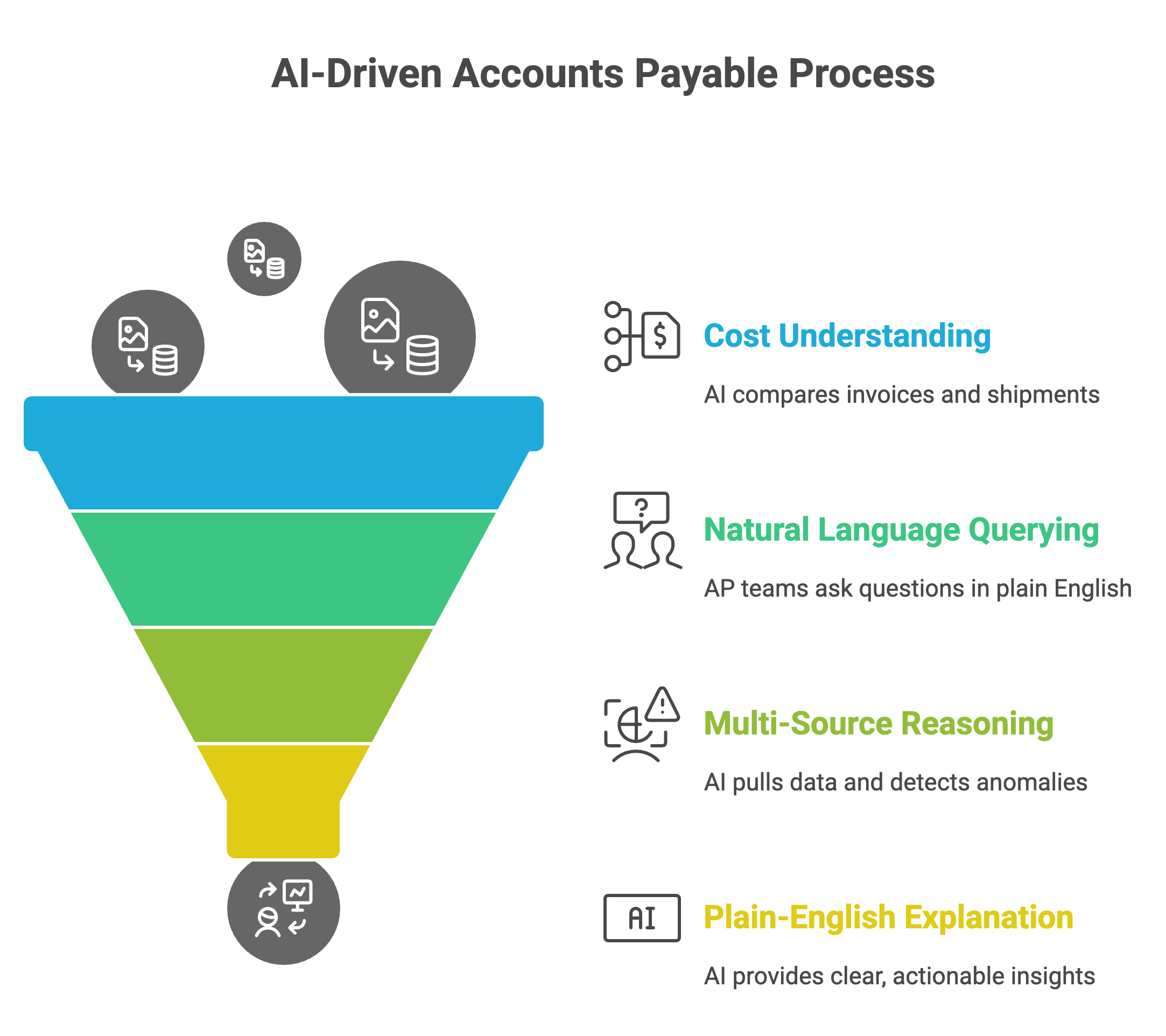
Step 1: Continuous cost understanding
The AI constantly compares:
- Invoiced amounts vs contracted expectations
- Current shipments vs historical patterns
This happens before humans ask questions.
Step 2: Natural-language querying by AP teams
Instead of running reports, AP asks:
- “Why did shipment #98432 cost more than usual?”
- “Show cost variance drivers for Carrier A this week.”
- “Are we seeing new accessorials on this lane?”
No SQL.
No pivot tables.
Step 3: AI performs multi-source reasoning
For a single question, the AI:
- Pulls similar historical shipments
- Breaks cost into components (base, fuel, accessorials)
- Detects rule changes or abnormal charges
- Pinpoints the exact cause, not just the delta
Step 4: Plain-English explanation output
Instead of numbers alone, the output looks like:
“This shipment is 11.2% higher due to a fuel surcharge increase from 24.8% to 29.6% effective August 1. Additionally, a ‘limited access delivery’ fee was applied for the first time on this lane.”
This explanation is:
- Shareable with customers
- Defensible internally
- Actionable for prevention
5. A Realistic End-to-End Example
The incoming problem
A customer challenges a monthly invoice total increase.
They want answers today, not next week.
Without AI (current reality)
- AP analyst spends 45 minutes investigating
- Ops confirms fuel surcharge change
- Customer receives response after 1–2 days
- Trust erodes
- Finance worries about leakage
With an AI AP Data Query Bot
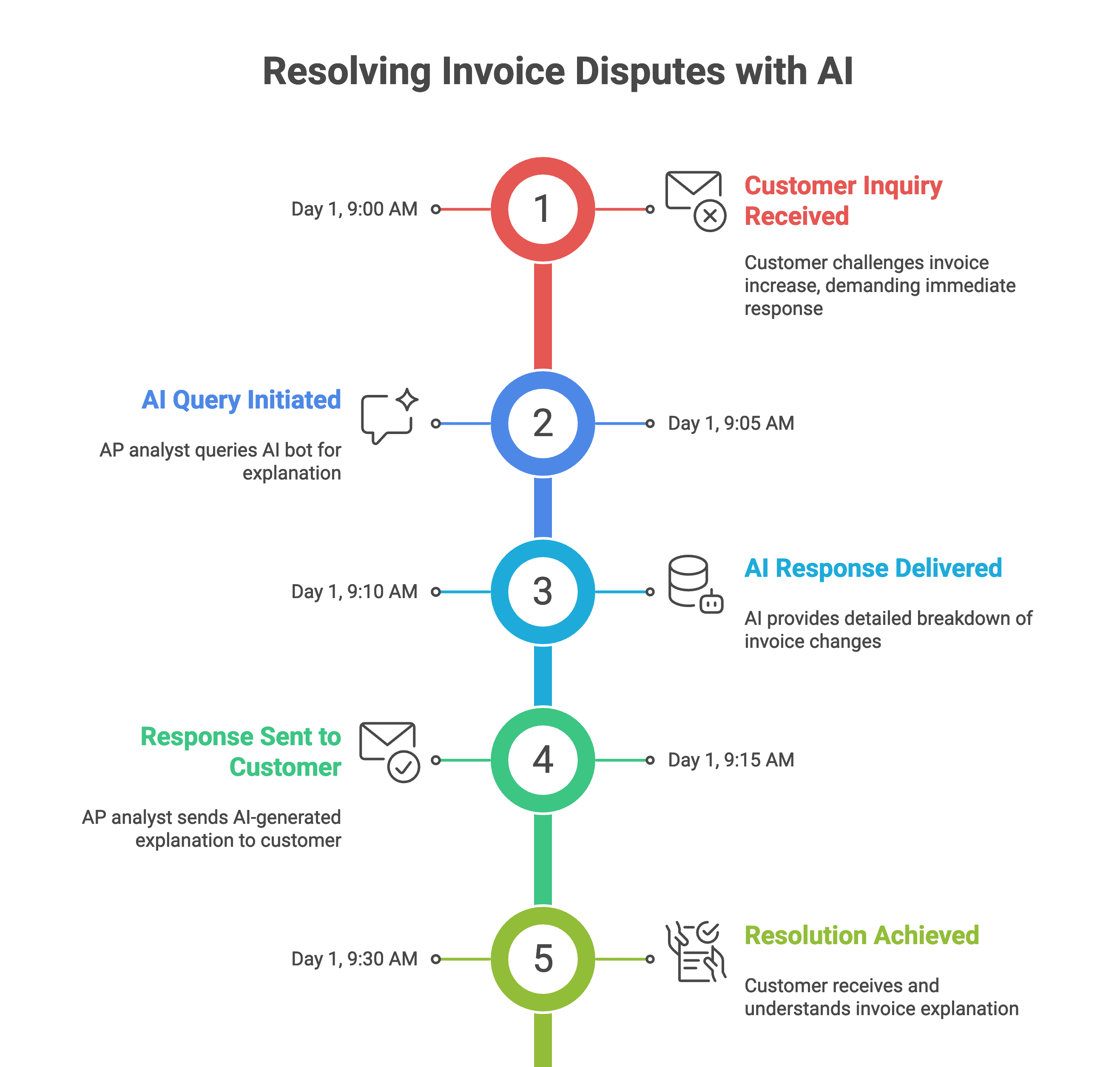
- AP receives the email
- Queries the AI:
“Explain customer XYZ’s August freight increase”
- AI returns:
- Fuel index shift contribution
- Two new accessorials introduced
- A carrier rate change applied mid-month
Total time: under 5 minutes.
The response goes out the same hour.
6. Before vs After: What Actually Changes

The biggest difference is confidence.
AP no longer hopes invoices are correct.
They know why they are.
7. KPIs That Move When AI Enters AP
Leadership notices impact in measurable ways:
- ⬇ Invoice dispute resolution time
- ⬇ Revenue leakage from unnoticed accessorials
- ⬆ Audit pass rates
- ⬆ AP throughput without adding headcount
But one KPI matters most:
Time-to-Explanation
When explanation time shrinks, trust expands.
8. Who Should Deploy AI AP Bots First
This use case delivers the fastest ROI for:
- 3PLs with high invoice volume
- Managed transportation providers handling multiple carriers
- Logistics companies with lean AP teams
- Any org facing frequent billing escalations
If your AP team says:
“We spend most of our time answering questions”
This is built for you.
9. Common Objections (and Why They Fall Apart)
“We already audit invoices”
Auditing tells you what is wrong.
AI tells you why it happened and whether it will repeat.
“This sounds risky”
AI does not approve payments.
It explains them.
Humans remain in control—but with better information.
“Our data is messy”
That’s exactly why this works.
AI is strongest where data is fragmented.
10. The Bigger Shift: AP as Margin Control, Not Clerical Work
AI doesn’t make AP faster for the sake of speed.
It does something more important:
- It moves AP from reactive firefighting
- To proactive margin protection
When explanations are instant, issues are caught earlier.
When issues are caught earlier, margins stabilize.
That’s not efficiency.
That’s control.
Free Session with Our Head of AI
30-Minute, no-strings-attached brainstorming session to identify potential bottlenecks and explore how AI can solve your business challenge.
Book Now →
11. How AI AP Data Query Bots Integrate with QuickBooks, ERPs, and TMS
AI-powered AP data query bots don’t live in isolation.
They sit between operational systems (TMS) and financial systems (QuickBooks, NetSuite, SAP, Oracle) and answer the most dangerous question in logistics finance:
“Do our accounting numbers actually reflect what moved on the ground?”
The Integration Reality (No Rip-and-Replace)
AI AP bots do not replace accounting or transportation systems.
They integrate with:
- TMS → shipment-level truth (lanes, weights, dates, carriers)
- Financial systems (QuickBooks, ERPs) → booked costs, accruals, payments
- Invoice sources → carrier PDFs, EDI feeds, emailed invoices
- Reference data → fuel indices, contracts, accessorial rule tables
The AI becomes the reasoning layer that reconciles them.
What the AI Correlates Across Systems
Traditional integrations move data.
AI integrations explain mismatches.
For every shipment, the AI correlates:
- TMS shipment cost expectations
- Carrier-invoiced line items
- Accounting system entries (accrued vs posted vs paid)
- Timing differences (shipment date vs invoice date vs posting date)
This allows AP teams to ask:
- “Why does QuickBooks show higher costs than TMS for this lane?”
- “Which invoices are posted but not tied to valid shipments?”
- “Are fuel surcharges booked correctly against shipment dates?”
No spreadsheet reconciliation.
No manual triage.
QuickBooks-Specific Example (What Finance Actually Cares About)
An AP manager notices a variance:
“August freight expense in QuickBooks is 6.8% higher than July, but shipment volume is flat.”
Without AI:
- AP pulls multiple reports
- Finance questions accrual accuracy
- Ops insists rates didn’t change
- Days are lost proving who is right
With an AI AP Data Query Bot:
The AP asks:
“Explain August freight expense increase vs July in QuickBooks.”
AI response:
- Fuel surcharge index increased mid-month and applied to shipments invoiced in August but shipped in late July
- Two accessorials were booked in QuickBooks but not mapped to expected TMS accessorial rules
- One carrier invoice was posted twice under different reference numbers
The books are corrected before close.
Why This Matters for Month-End Close
The fastest path to CFO trust isn’t automation.
It’s explainability at close time.
AI AP bots:
- Catch mis-posted invoices
- Flag shipment-to-invoice mismatches
- Surface accrual risks before financial close
- Reduce last-week-of-the-month chaos
AP stops being the bottleneck.
It becomes a control point.
Final Takeaway
Logistics AP was never supposed to scale this way.
Humans were not meant to manually reconcile thousands of invoices, explain pricing logic across systems, and answer stakeholders in real time.
AI Accounts Payable Data Query Bots don’t replace AP teams.
They give them their authority back.
Our team helps high-volume logistics organizations reduce execution errors and prevent billing leakage using AI.
If AI implementation is on your radar this year, check out how we can help and other high ROI use cases and case studies here: https://symphonize.com/logistics-ai


.png)

.png)


Christian Financial Credit Union
Huntington National Bank
Paqqets
Meridian Medical Management
Thales Group
Meridian Medical Management