


Annual freight rerates are one of the most expensive and time-consuming processes in logistics — yet most still rely on spreadsheets, averages, and intuition.
The result is short-lived savings and recurring cost surprises.
This article breaks down how AI-powered rerate engines analyze volatility, lane behavior, and carrier risk to give procurement teams real negotiation leverage that actually holds after renewal.
If rerates feel exhausting, political, and only partially effective, this article will explain why—and how AI fundamentally changes the outcome.
1. The Uncomfortable Truth About Freight Rerates
Annual rerates are one of the most important moments in logistics.
They directly impact:
- Cost structure
- Carrier relationships
- Service reliability
- Customer profitability
Yet most rerates rely on shallow analysis relative to what’s at stake.
What rerates look like in reality
- Teams export shipment history into spreadsheets
- Averages are calculated by lane or carrier
- A few “problem lanes” are highlighted
- Negotiations begin
Despite weeks of preparation, outcomes often feel underwhelming.
Six months later:
- Costs creep back up
- Service complaints persist
- Leadership questions why rerates didn’t “stick”
This isn’t due to poor negotiators.
It’s due to poor signal quality.
2. Why Traditional Rerate Analysis Fails at Scale
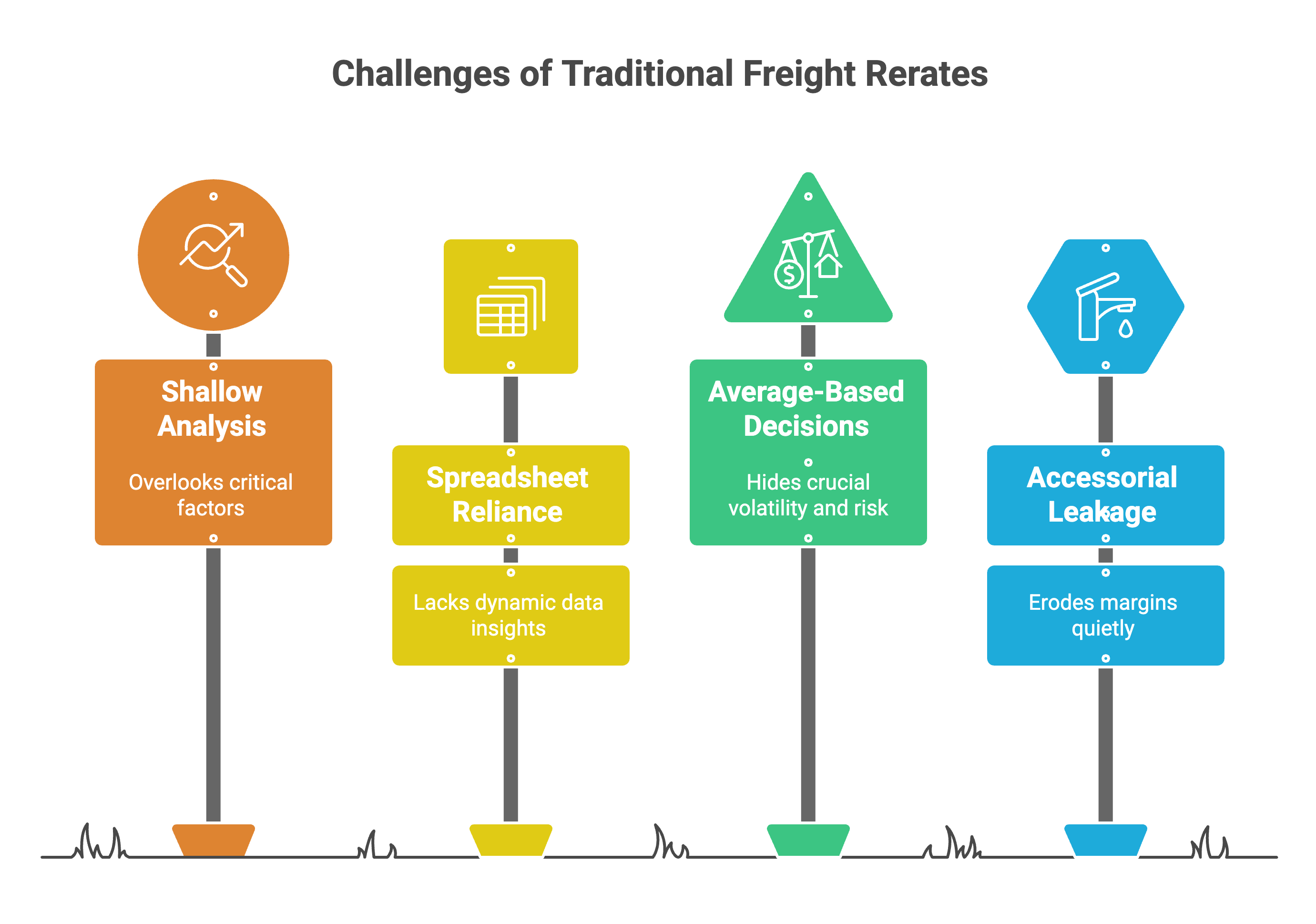
Most rerate processes rely on averages.
Averages hide exactly what matters most.
Averages hide volatility
Two lanes may both average $2.10/mile.
But:
- Lane A is consistently stable
- Lane B swings wildly based on season, carrier, or accessorials
Only one of these is dangerous.
Averages hide concentration risk
A carrier might look acceptable overall but:
- Control 70% of your most volatile lanes
- Generate the majority of service failures
Traditional spreadsheets don’t surface this clearly.
Averages hide accessorial leakage
Accessorials don’t show up cleanly in base-rate analysis.
But they quietly erode margin across the year.
3. What an AI-Powered Rerate Engine Actually Does
An AI-Powered Freight Rerate System does not negotiate for you.
It does something far more valuable:
👉 It structures negotiation leverage before conversations even begin.
Data the AI ingests continuously
- 12–24 months of shipment history
- Lane-level volume and cost data
- Accessorial frequency and cost
- Fuel surcharge variability
- Carrier service metrics
- Seasonal patterns
Instead of asking, “What’s our average cost?”
AI asks, “Where does risk concentrate?”
4. How AI Analyzes Freight Data Differently (Step-by-Step)
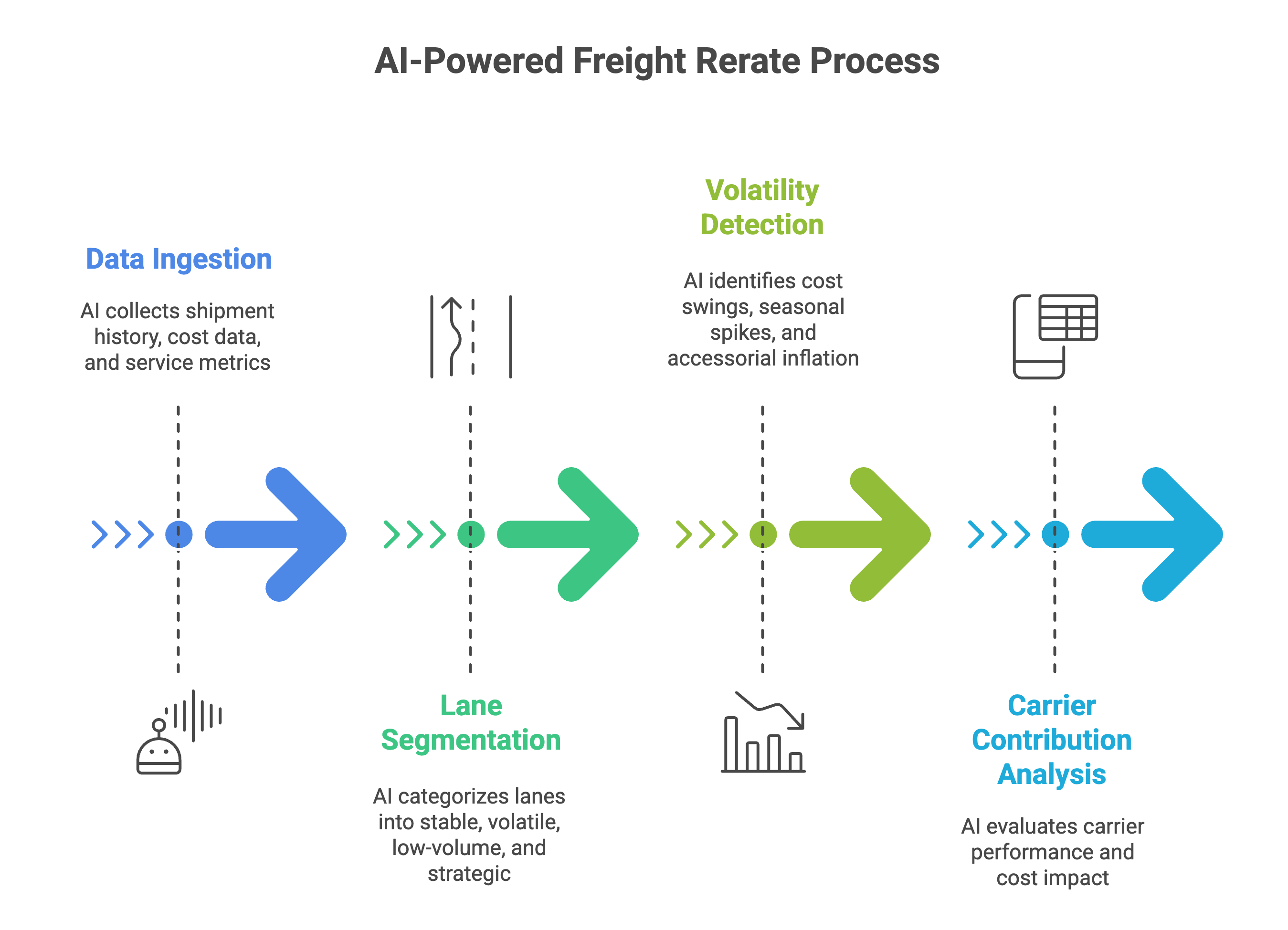
Step 1: Lane segmentation (not just lane averages)
AI breaks lanes into:
- Stable profit lanes
- Volatile cost lanes
- Low-volume, high-cost lanes
- Strategic lanes tied to key customers
This segmentation immediately tells procurement:
- Where negotiation matters
- Where renegotiation is wasteful
Step 2: Volatility and variance detection
Instead of focusing on:
“What is the average rate?”
AI highlights:
- Cost swings
- Seasonal spikes
- Accessorial-driven inflation
This reframes negotiations from price arguments to risk conversations.
Step 3: Carrier contribution analysis
AI answers uncomfortable but critical questions:
- Which carriers drive the most volatility?
- Which carriers look cheap but generate downstream cost?
- Which carriers perform well only under certain conditions?
This moves discussions from:
“We need a 5% reduction”
to
“We need predictable execution on these lanes.”
5. A Real-World Example (End-to-End)
The rerate challenge
A mid-size 3PL runs an annual rerate across ~1,200 lanes.
The traditional analysis shows:
- Carrier X is cheapest on average
- Carrier Y is slightly more expensive
Historically, Carrier X receives more volume.

What AI uncovers
AI identifies:
- Carrier X causes 38% of late deliveries on top-volume lanes
- Carrier X’s accessorial costs spike during peak months
- Carrier Y is more consistent on high-value customer lanes
AI recommends:
- Move volatile lanes away from Carrier X
- Retain Carrier X only on stable, predictable lanes
- Renegotiate Carrier X based on risk, not price
Negotiation outcome
Instead of asking for blanket reductions, procurement says:
“We will expand your volume on stable lanes if cost volatility is capped on these specific routes.”
Negotiations shift from price confrontation to structural alignment.
6. Before vs After: What AI Changes in Rerates

The biggest difference:
AI makes rerates stick.
7. KPIs That Improve After AI-Driven Rerates
Leadership sees impact in:
- ⬇ Cost volatility (not just cost)
- ⬇ Surprise accessorial spend
- ⬆ Carrier accountability
- ⬆ Forecast accuracy
But the most powerful metric is:
Cost predictability per lane
Predictability beats small price concessions every time.
8. Who AI-Powered Rerates Are Built For
This use case delivers the highest ROI for:
- Logistics companies with complex lane networks
- 3PLs managing multiple carriers across customers
- Procurement teams overwhelmed by data prep
- Organizations where rerates “never fully fix the problem”
If your team says:
“We renegotiate every year, but costs still creep back”
AI is addressing that exact gap.
9. Common Objections (and Reality)
“We already renegotiate aggressively”
Aggressive negotiation without precision simply shifts problems elsewhere.
AI ensures pressure is applied where it actually matters.
“Our carriers won’t accept this”
Carriers already use analytics.
AI allows you to speak the same language—with better data.
“This sounds complex”
AI simplifies complexity.
Humans shouldn’t manually reason across millions of data points.
Free Session with Our Head of AI
30-Minute, no-strings-attached brainstorming session to identify potential bottlenecks and explore how AI can solve your business challenge.
Book Now →.png)
10. The Bigger Shift: Rerates as Strategy, Not Ritual
Traditional rerates are:
- Time-bound
- Exhaustive
- Quickly outdated
AI turns rerates into:
- Continuous insight
- Ongoing leverage
- Strategic portfolio management
Negotiation stops being a calendar event.
It becomes an always-informed position.
Final Takeaway
Freight rerates fail when teams negotiate on averages instead of behavior.
AI doesn’t make procurement aggressive.
It makes procurement precise.
And in logistics, precision beats pressure every time.


.png)

.png)
.png)


Christian Financial Credit Union
Huntington National Bank
Paqqets
Meridian Medical Management
Thales Group
Meridian Medical Management